
 Call us now:

What Is Included in Custom Underwear Manufacturing Cost?
When developing a custom underwear collection, one of the first questions brands ask is: How much does custom underwear manufacturing cost?
There is no single standard price because the final manufacturing cost depends on the product specifications, materials, order quantity, customization requirements, production process, and quality standards.
Two underwear products that look similar can have significantly different production costs because of differences in fabric composition, GSM, waistband construction, branding, packaging, order quantity, or quality requirements.
Understanding the main custom underwear manufacturing cost factors can help brands prepare a more accurate RFQ, compare supplier quotations correctly, and avoid unexpected costs during sampling and bulk production.
In this guide, we explain the 7 major factors that affect custom underwear manufacturing cost and how brands can manage each one during product development.
Before comparing quotations, it is important to understand what the quoted price actually covers.
A custom underwear manufacturing quotation may include some or all of the following:
- Fabric and raw materials
- Cutting and sewing
- Waistband and elastic components
- Printing or embroidery
- Labels and tags
- Packaging
- Sampling and product development
- Quality inspection
- Production labor
Other costs, such as shipping, duties, taxes, testing, special certifications, or third-party inspection, may be quoted separately depending on the supplier and order terms.
For this reason, brands should compare quotations based on the same product specifications and commercial terms, rather than comparing the unit price alone.
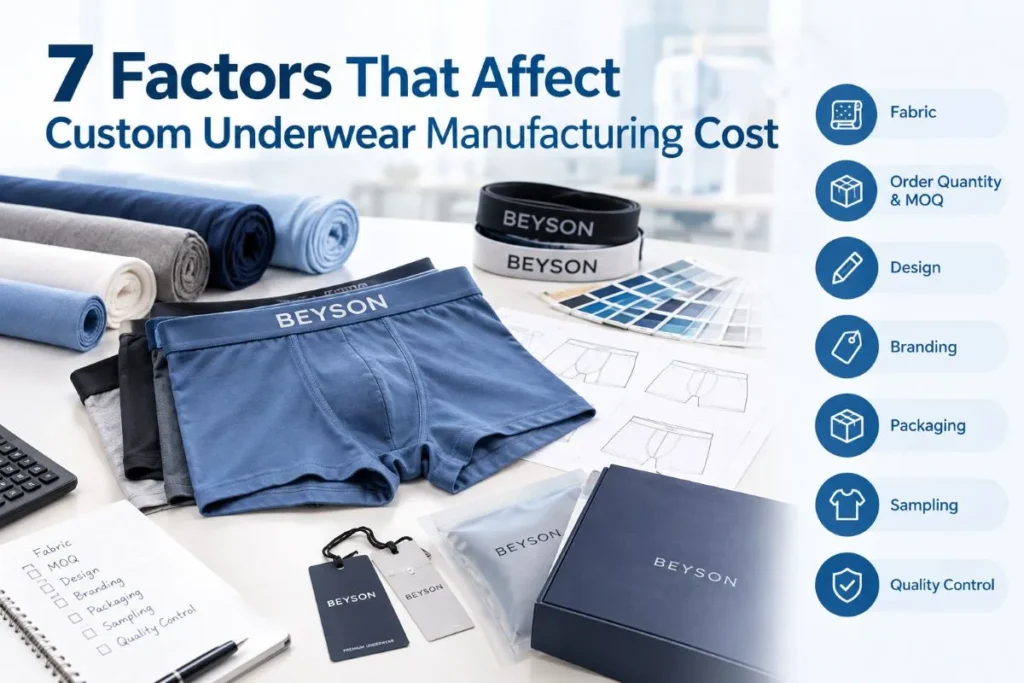
7 Factors That Affect Custom Underwear Manufacturing Cost
The seven major factors are:
- Fabric composition and GSM
- Order quantity and MOQ
- Product design and construction
- Waistband and branding customization
- Labels, trims, and packaging
- Sampling and product development
- Quality requirements and production standards
Each factor can influence the final cost independently, but they also interact with each other. For example, a complex design combined with a premium fabric and highly customized packaging can increase the total manufacturing cost considerably.
1. Fabric Composition and GSM
Fabric is one of the most important factors affecting custom underwear manufacturing cost.
Different fibers, fabric constructions, GSM levels, finishing processes, and blend ratios can result in different material costs.
Common materials used for custom underwear include:
- Cotton
- Modal
- Bamboo-based fabrics
- Nylon
- Polyester
- Elastane or spandex blends
- Mixed-fiber fabrics
For example, a basic cotton underwear product may have a different material cost from a premium modal or bamboo-based product. Even within the same fiber category, fabric quality and construction can vary significantly.
GSM also matters. A heavier fabric generally uses more material per garment, although GSM should always be evaluated together with fabric construction and garment design.
When comparing fabrics, brands should consider:
- Fiber composition
- GSM
- Stretch percentage
- Stretch recovery
- Hand feel
- Durability
- Shrinkage
- Color requirements
- Finishing requirements
Our guide on how to choose the best fabric for custom underwear explains how fabric selection affects product performance, positioning, and manufacturing requirements.
For brands developing men’s boxer briefs, you can also read our detailed guide on choosing fabric for custom boxer briefs, including GSM, stretch, recovery, and fiber composition.
2. Order Quantity and MOQ
Order quantity has a direct impact on custom underwear manufacturing cost.
Manufacturers have fixed and variable production costs. When these costs are distributed across a larger production quantity, the unit economics can change.
However, brands should not assume that ordering a larger quantity will automatically produce a lower quotation. The actual pricing structure depends on fabric purchasing, production efficiency, customization, packaging, and other project requirements.
MOQ can also vary depending on:
- Product style
- Color
- Fabric
- Waistband
- Custom dyeing
- Labels
- Packaging
- Special production processes
For startups, a lower MOQ can reduce initial inventory exposure, but smaller orders may have different unit economics than larger production runs.
When requesting a quotation, clearly state your expected quantity and ask whether the MOQ applies per style, color, size, or fabric.
Our guide to choosing a custom underwear manufacturer explains why MOQ should be evaluated together with customization, sampling, quality control, and production capability.
3. Product Design and Construction
The complexity of the underwear design can significantly affect production cost.
A simple basic brief may require fewer operations than a technically engineered boxer brief with multiple panels, special seams, a structured pouch, decorative stitching, or performance construction.
Design factors that can affect manufacturing cost include:
- Number of pattern pieces
- Construction complexity
- Special seam structures
- Flatlock or other specialized stitching
- Panel construction
- Pouch design
- Leg opening construction
- Special finishing
- Fit and grading requirements
The more production operations a garment requires, the more important it becomes to provide accurate technical specifications before requesting a quotation.
A manufacturer should be able to review your design or tech pack and identify construction requirements before calculating the final production cost.
This is also one reason why brands should not compare quotations from different suppliers based only on a product photo. Two manufacturers may interpret the same reference image differently and quote different construction specifications.
4. Waistband and Branding Customization
The waistband is one of the most visible and technically important components of custom underwear.
Brands can choose from different waistband constructions and branding methods, including:
- Jacquard elastic waistbands
- Printed elastic waistbands
- Different waistband widths
- Custom waistband colors
- Logo placement
- Custom elastic specifications
The type of waistband, artwork, width, material, and production process can all influence the final manufacturing cost.
For example, a simple standard waistband may require fewer custom production steps than a fully customized branded jacquard waistband.
If you are developing a branded underwear collection, read our guide on custom underwear labels to understand how woven, printed, and heat-transfer branding options can affect the finished product.
You can also compare jacquard vs. printed elastic waistbands before finalizing your waistband specification.
5. Labels, Trims, and Packaging
Custom underwear manufacturing cost is not limited to the garment itself.
Additional components can include:
- Woven labels
- Printed labels
- Heat-transfer care labels
- Hangtags
- Barcodes
- Size labels
- Care labels
- Custom polybags
- Custom boxes
- Paper inserts
- Other retail packaging
Packaging requirements can vary substantially between brands.
A simple bulk polybag can have a very different cost structure from a premium retail box with custom printing, inserts, stickers, and multiple packaging components.
When requesting a quotation, provide your packaging specifications as early as possible so the manufacturer can include them in the cost calculation.
This is especially important for private label brands because packaging is part of the final product presentation rather than simply an afterthought.
6. Sampling and Product Development
Sampling is another cost factor that brands should consider when developing custom underwear.
A simple sample based on an existing pattern may require less development work than a completely new product that requires pattern development, multiple fittings, fabric testing, and several rounds of revisions.
Development costs can be influenced by:
- Pattern development
- Fabric sourcing
- Custom colors
- Sample construction
- Logo development
- Waistband development
- Fit revisions
- Multiple sample rounds
- Pre-production sample requirements
Before requesting samples, clarify whether sample fees are charged separately and whether they can be credited against a future bulk order.
You should also confirm what is included in the sampling service and how many revisions are expected.
Our guide on how to request an underwear manufacturing sample explains the different sample stages and the information brands should provide to manufacturers.
7. Quality Requirements and Production Standards
Higher quality requirements can also affect custom underwear manufacturing cost.
Quality control may include additional checks for:
- Fabric composition
- Color consistency
- Garment measurements
- Stretch and recovery
- Seam quality
- Waistband attachment
- Logo placement
- Label accuracy
- Packaging accuracy
- Final appearance
Brands selling underwear in international markets may also have specific testing, labeling, or compliance requirements depending on their destination market and product specifications.
Quality requirements should therefore be discussed before production rather than after the goods have been manufactured.
A clear quality standard can help both the buyer and manufacturer understand what needs to be inspected and what tolerances are acceptable.
How Fabric, MOQ, and Customization Work Together
The seven cost factors should not be considered separately.
For example, a brand may choose:
- Premium modal fabric
- Custom dyed colors
- Custom jacquard waistband
- Private label packaging
- Small initial order quantity
- Multiple sample revisions
Each requirement can add cost, but the combination can have an even greater effect on the final quotation.
This is why a complete RFQ is more useful than simply asking:
“What is your price for 1,000 pieces of underwear?”
Instead, provide the manufacturer with your product specifications so the quotation is based on the same requirements.
What Should You Include in a Custom Underwear RFQ?
A detailed RFQ can help manufacturers calculate your production cost more accurately.
| Specification | What to Provide |
|---|---|
| Product | Briefs, boxer briefs, panties, trunks, etc. |
| Fabric | Fiber composition, GSM, stretch, finish |
| Colors | Color references or Pantone requirements |
| Sizes | Size range and measurement chart |
| Waistband | Width, material, construction, artwork |
| Branding | Logo, labels, tags, printing requirements |
| Packaging | Polybag, box, inserts, barcode, etc. |
| Quantity | Total pieces and quantity by color/size |
| Quality | Inspection requirements and tolerances |
The more complete your RFQ is, the easier it becomes for different manufacturers to quote the same product specification.
How to Compare Custom Underwear Manufacturing Quotes
When comparing supplier quotations, do not look at the unit price alone.
Check whether each supplier is quoting the same:
- Fabric composition
- Fabric GSM
- Color specification
- Size range
- Waistband construction
- Branding method
- Labels
- Packaging
- Quantity
- Quality requirements
- Shipping terms
A quotation that appears cheaper may exclude certain components or use a different fabric, packaging method, or quality specification.
For this reason, the best way to compare suppliers is to create a standardized RFQ and request quotations based on identical requirements.
How to Reduce Custom Underwear Manufacturing Cost
Reducing manufacturing cost does not necessarily mean choosing the cheapest fabric or supplier.
Brands can manage costs by optimizing the product specification.
1. Choose Fabric Based on Product Requirements
Select a fabric that matches the intended product positioning and performance requirements instead of automatically choosing the most expensive material.
2. Optimize Order Quantity
Plan quantities based on realistic sales expectations while understanding how MOQ and production volume affect your quotation.
3. Simplify Unnecessary Construction Details
Remove construction elements that do not contribute meaningful functional or visual value to the final product.
4. Standardize Colors Where Possible
Reducing the number of custom colors may simplify fabric and production management, depending on the project.
5. Plan Branding Early
Confirm labels, waistbands, logos, and packaging before sampling to reduce unnecessary revisions and development changes.
6. Provide a Clear Tech Pack or Product Specification
Accurate specifications can reduce misunderstandings and unnecessary sample revisions.
If you are still selecting a manufacturing partner, our guide on how to choose a custom underwear manufacturer explains the broader factors to evaluate beyond price.
Common Mistakes When Estimating Custom Underwear Cost
Comparing Only Unit Prices
A low unit price does not necessarily represent the lowest total production cost if important components are excluded from the quotation.
Ignoring Fabric Specifications
Two suppliers may use the same general fabric name while offering different compositions, GSM, stretch, recovery, or finishing.
Changing Specifications After Sampling
Major changes to fabric, construction, colors, or packaging after sampling can affect both cost and production timing.
Forgetting Packaging and Branding
Labels, waistbands, hangtags, boxes, and other branding components should be included when calculating the complete product cost.
Not Considering Future Reorders
If your brand plans to reorder the same product, consider whether the manufacturer can maintain consistent fabric, color, construction, and branding specifications across production runs.
Custom Underwear Manufacturing Cost Checklist
| Cost Factor | Questions to Check |
|---|---|
| Fabric | What composition, GSM, stretch, and finishing are required? |
| Quantity | What is the quantity per style, color, and size? |
| Design | How complex is the construction? |
| Waistband | What type, width, material, and artwork are required? |
| Branding | Which labels, logos, tags, and printing methods are needed? |
| Packaging | What packaging configuration is required? |
| Sampling | How many development and revision rounds are required? |
| Quality | What inspection standards and tolerances apply? |
Why Custom Underwear Quotes Can Vary Between Manufacturers
It is normal for different manufacturers to provide different quotations for the same general underwear concept.
The difference may come from:
- Different fabric suppliers
- Different fabric quality
- Different production processes
- Different labor and overhead structures
- Different MOQ policies
- Different quality standards
- Different packaging solutions
- Different levels of product development support
Therefore, brands should ask manufacturers to explain what is included in their quotation rather than assuming that a lower price represents a better manufacturing solution.
Why Work With an Experienced Custom Underwear Manufacturer?
An experienced manufacturer can help brands evaluate the relationship between product specifications, manufacturing processes, and production cost.
Beyson Apparel provides custom underwear OEM and ODM manufacturing for brands, startups, retailers, and B2B buyers.
Our capabilities cover:
- Fabric sourcing and selection
- Product development
- Pattern and fit development
- Sampling
- Custom waistbands
- Custom labels
- Logo and branding
- Custom packaging
- Quality inspection
- Bulk production
Brands can learn more about our custom underwear manufacturing capabilities before requesting a project quotation.
Final Thoughts
The cost of custom underwear manufacturing is determined by much more than the garment itself.
The seven major factors include fabric, order quantity, product design, waistband and branding, labels and packaging, sampling, and quality requirements.
Understanding these factors before requesting a quotation allows brands to create a clearer product specification and compare manufacturers more accurately.
Instead of asking only for the lowest unit price, focus on the complete relationship between product quality, specifications, customization, MOQ, production requirements, and total cost.
A well-prepared RFQ can make the quotation process more transparent and help reduce unexpected changes before bulk production.
Request a Custom Underwear Manufacturing Quote
Planning a new underwear collection or private label product?
Send your product type, fabric requirements, target quantity, customization details, and packaging specifications to our team.
📩 Email: sales@beysonapparel.com
Beyson Apparel supports custom underwear OEM and ODM projects from product development and sampling through quality inspection and bulk production.
* This article was written by the manufacturing team of Beyson Apparel. We are a clothing ODM/OEM factory with 15+ years of experience, covering products such as Underwear, T-shirt, Polo Shirts, Hoodies, Pajamas, Shorts and more. Direct inquiry, reply within 12 hours *