
 Call us now:

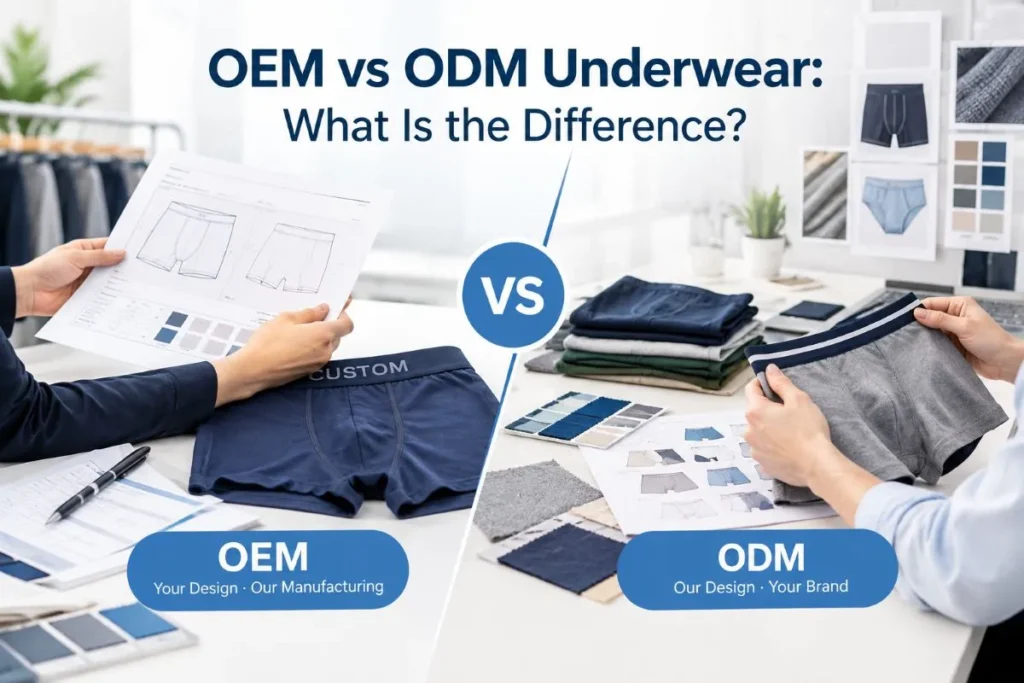
When developing a private label underwear collection, brands often need to decide between OEM and ODM underwear manufacturing. Although the two models are closely related, they involve different levels of design ownership, product development support, customization, and manufacturer involvement.
Understanding the difference between OEM and ODM underwear can help brands choose the right manufacturing process before requesting samples, comparing quotations, or starting bulk production.
In simple terms, OEM underwear manufacturing is generally based on the buyer’s own design and specifications, while ODM underwear manufacturing gives the manufacturer a larger role in product development and design adaptation.
This guide explains how OEM and ODM underwear manufacturing work, how they differ, and what brands should consider when choosing between the two models.
What Does OEM Mean in Underwear Manufacturing?
OEM stands for Original Equipment Manufacturing. In an OEM underwear project, the brand generally provides the product concept, design, specifications, technical information, or tech pack, while the manufacturer produces the underwear according to those requirements.
The exact responsibilities can vary between manufacturers, but an OEM underwear project commonly involves:
- Brand-provided product design
- Technical specifications or tech pack
- Custom fabric requirements
- Custom colors and Pantone references
- Custom sizing and measurements
- Custom waistband specifications
- Brand logos and labels
- Custom packaging
- Sample development
- Bulk production
For example, a brand may already have a specific boxer brief design, including the pattern, measurements, fabric composition, waistband artwork, logo placement, and packaging requirements. The OEM manufacturer then develops samples and produces the final product according to those specifications.
If you are still developing your technical specifications, our guide to custom underwear engineering, fabrics, and tech pack execution provides a deeper look at the technical side of underwear development.
What Does ODM Mean in Underwear Manufacturing?
ODM stands for Original Design Manufacturing. In an ODM underwear project, the manufacturer usually contributes more to product development.
Instead of starting entirely from a finished design, the brand may begin with a product idea, reference garment, market positioning, preferred fabric, or general design direction.
The manufacturer may then provide support with:
- Existing underwear styles
- Pattern development
- Fit recommendations
- Fabric selection
- Construction suggestions
- Waistband development
- Sample development
- Design modifications
- Technical recommendations
- Production optimization
For example, a startup may want to launch a premium men’s boxer brief collection but does not yet have a complete tech pack. An ODM manufacturer may help develop the pattern, recommend suitable fabrics, adjust the fit, and create samples based on the brand’s requirements.
This makes ODM particularly relevant when a brand has a clear product concept but limited in-house technical development resources.
OEM vs ODM Underwear: Key Differences
The main difference between OEM and ODM is the level of manufacturer involvement in product development.
| Factor | OEM Underwear | ODM Underwear |
|---|---|---|
| Product design | Usually provided by the brand | Manufacturer contributes to development |
| Tech pack | Usually brand-provided | May be developed or adapted with manufacturer support |
| Customization | Highly customizable | Customizable based on available designs and development capabilities |
| Manufacturer involvement | Primarily manufacturing and technical execution | Higher product development involvement |
| Development starting point | Brand's finished concept or specifications | Brand concept, reference, or manufacturer design |
| Brand control | Generally higher control over specifications | Depends on the development arrangement |
| Development support | Based on manufacturer capability | Usually a more important part of the service |
OEM vs ODM Underwear: How the Design Process Works
Typical OEM Underwear Process
A typical OEM underwear project may follow this workflow:
- Brand develops the product concept
- Brand prepares the design or tech pack
- Manufacturer reviews specifications
- Fabric and production details are confirmed
- Manufacturer develops the sample
- Brand reviews and requests revisions
- Pre-production sample is approved
- Bulk production begins
- Quality inspection and packaging are completed
This approach gives the brand a relatively direct role in defining the product specifications.
For a detailed look at the sampling stage, see How to Request an Underwear Manufacturing Sample.
Typical ODM Underwear Process
An ODM project may start with a less-developed product concept:
- Brand provides product concept or market requirements
- Manufacturer discusses styles, fabrics, fit, and construction
- Suitable existing designs or development directions are proposed
- Product specifications are adapted for the brand
- Prototype samples are developed
- Brand reviews fit, fabric, and appearance
- Revisions are completed
- Pre-production sample is approved
- Bulk production begins
The exact workflow depends on how much product development support the manufacturer provides.
OEM vs ODM: Which Model Offers More Customization?
OEM and ODM can both support customized underwear, but the customization process is different.
With OEM, brands typically have greater control over the exact product specifications because they provide the design direction and technical requirements.
Customization may include:
- Fabric composition
- Fabric weight
- Colors
- Size specifications
- Pattern construction
- Waistband width
- Waistband artwork
- Logo placement
- Labels
- Packaging
ODM can also provide substantial customization, but the development process may begin with an existing manufacturer design or a product concept that is then modified for the brand.
For example, a brand may start with an existing boxer brief silhouette and customize the fabric, color, waistband, logo, labels, and packaging rather than developing every construction detail from zero.
OEM vs ODM Underwear and Fabric Selection
Fabric selection is an important part of both OEM and ODM underwear manufacturing.
Common underwear materials include:
- Cotton
- Organic cotton
- Modal
- Bamboo viscose
- Nylon
- Polyester
- Spandex or elastane blends
OEM projects may begin with a specific fabric composition and fabric specification supplied by the brand. ODM projects may involve more manufacturer recommendations based on the desired hand feel, stretch, moisture management, price target, and product positioning.
Brands developing boxer briefs can also review our guide on how to choose fabric for custom boxer briefs for a more detailed discussion of fabric composition, GSM, stretch, and recovery.
For cotton-focused collections, our guide to choosing a cotton underwear manufacturer covers fabric sourcing, customization, MOQ, sampling, quality control, and production considerations.
OEM vs ODM Underwear: What About Branding?
Both OEM and ODM manufacturing can support private label branding.
Depending on the manufacturer, branding options may include:
- Woven labels
- Printed labels
- Heat transfer labels
- Jacquard waistbands
- Printed waistbands
- Hangtags
- Barcodes
- Custom packaging
The choice of branding method can affect product appearance, comfort, production requirements, and cost.
For a detailed comparison, read Custom Underwear Labels: Woven, Printed, and Heat Transfer Options.
Waistband branding is also particularly important for underwear because the waistband can become one of the most visible elements of the product. See Jacquard vs. Printed Elastic Waistband for a detailed comparison of the two approaches.
OEM vs ODM Underwear and MOQ
MOQ, or minimum order quantity, can vary between manufacturers and production models.
OEM projects may involve MOQ requirements related to:
- Style
- Color
- Fabric
- Custom waistband
- Custom packaging
- Special dyeing or finishing
ODM projects may offer existing materials, patterns, or production processes that can simplify certain development requirements, although MOQ still depends on the specific manufacturer and customization level.
For startups, MOQ can be particularly important because the initial order needs to balance product testing, inventory investment, and customization requirements.
Our guide to choosing a custom underwear manufacturer explains how to evaluate MOQ alongside sampling, product development, customization, quality control, and production capacity.
OEM vs ODM Underwear: Cost Considerations
There is no universal rule that OEM underwear is cheaper or more expensive than ODM underwear.
The final cost depends on the complete product specification and manufacturing requirements.
Factors that can affect the cost include:
- Fabric composition and GSM
- Order quantity
- Pattern complexity
- Number of colors
- Custom dyeing
- Waistband construction
- Printing or embroidery
- Labels and trims
- Packaging
- Sampling and development
- Quality requirements
- Shipping terms
For this reason, brands should compare quotations using the same specifications rather than comparing only the headline unit price.
When Does OEM Underwear Manufacturing Make Sense?
OEM manufacturing can be suitable when a brand already has a relatively developed product concept and wants the manufacturer to execute specific requirements.
OEM may be relevant when you already have:
- A complete design
- A detailed tech pack
- Specific measurements
- Defined fabric requirements
- Custom artwork
- Specific waistband requirements
- Defined packaging specifications
For example, an established underwear brand may already have a proven product and simply needs a manufacturing partner capable of reproducing the product consistently at commercial scale.
When Does ODM Underwear Manufacturing Make Sense?
ODM manufacturing can be useful when a brand has a product direction but does not have all the technical resources required to develop the garment independently.
ODM may be considered when you need support with:
- Product development
- Pattern making
- Fabric recommendations
- Fit development
- Construction decisions
- Sample development
- Product modifications
This model can be particularly relevant to startups and emerging brands that have a strong market concept but are still building their internal product development capabilities.
Can a Manufacturer Provide Both OEM and ODM Underwear?
Yes. Many apparel manufacturers provide both OEM and ODM services, allowing brands to choose different levels of development support for different products.
For example, a brand might use ODM development for a new boxer brief collection while using OEM production for an existing product that already has an established tech pack.
This flexible approach can be useful when a brand has multiple product categories or is gradually expanding its collection.
When evaluating a manufacturer, ask specifically:
- Do you provide OEM, ODM, or both?
- Can you work from a complete tech pack?
- Can you develop products from sketches or reference garments?
- Can you modify existing styles?
- Who controls the final specifications?
- How many sample revisions are included?
- What customization options are available?
- What are the MOQ requirements?
OEM vs ODM vs Private Label Underwear
OEM and ODM are manufacturing models, while private label describes a broader brand and product ownership arrangement.
A private label underwear project can use either OEM or ODM manufacturing.
For example:
- Private Label + OEM: The brand provides the product specifications and the manufacturer produces the underwear with the brand’s labels and packaging.
- Private Label + ODM: The manufacturer supports product development while the final product is branded and sold under the customer’s brand.
This distinction is important because private label does not automatically mean ODM. A private label project can be developed using different manufacturing models depending on the relationship between the brand and manufacturer.
Questions to Ask an OEM or ODM Underwear Manufacturer
Before selecting a supplier, prepare a clear list of questions.
| Area | Questions to Ask |
|---|---|
| Manufacturing Model | Do you provide OEM, ODM, or both? |
| Product Development | Can you develop products from sketches, reference garments, or tech packs? |
| Fabric | Which fabrics and blends can you source? |
| Customization | Can you customize colors, sizes, waistbands, labels, and packaging? |
| Sampling | What is the sample development and revision process? |
| MOQ | What is the MOQ per style, color, fabric, and customization? |
| Quality Control | How do you control quality during bulk production? |
| Lead Time | What is the expected timeline from sample approval to shipment? |
How to Choose Between OEM and ODM Underwear Manufacturing
The decision depends mainly on how much product development work your brand wants to manage internally and how much support you expect from the manufacturer.
Consider the following factors:
- How complete is your product design?
- Do you already have a tech pack?
- Do you have an established pattern?
- Do you know which fabric you want to use?
- How much fit-development support do you need?
- How important is control over technical specifications?
- How much product development capacity does your team have?
- What MOQ and production requirements do you have?
The answers to these questions can help you determine the appropriate manufacturing workflow for your project.
Why Work With an OEM and ODM Underwear Manufacturer?
For many B2B underwear brands, the most useful manufacturing partner is one that can support both clearly defined OEM projects and more development-intensive ODM projects.
Beyson Apparel provides custom underwear OEM and ODM manufacturing, supporting product development, fabric selection, sampling, custom branding, waistbands, labels, packaging, quality inspection, and bulk production.
Our custom underwear manufacturer guide explains the broader factors brands should evaluate when selecting a manufacturing partner.
For brands developing a private label collection, you can also explore our custom underwear labeling guide to understand how woven, printed, and heat transfer labels can be incorporated into the product.
Final Thoughts
The difference between OEM and ODM underwear manufacturing mainly comes down to who provides the product development direction and how involved the manufacturer is in developing the product.
OEM manufacturing generally works from the brand’s own product specifications, designs, or tech packs. ODM manufacturing gives the manufacturer a larger role in product development, including design adaptation, fabric recommendations, pattern development, and technical support.
Both models can support custom branding, private labels, custom fabrics, waistbands, packaging, and bulk production. The appropriate model depends on your product development requirements, internal capabilities, customization needs, and manufacturing expectations.
Before starting production, clarify the scope of development, ownership of specifications, sample approval process, MOQ, quality standards, lead time, and customization requirements with your manufacturer.
Looking for an OEM or ODM Underwear Manufacturer?
Have a design, tech pack, reference garment, or product concept? Beyson Apparel supports custom underwear OEM and ODM manufacturing for brands, startups, retailers, and B2B buyers.
We can support fabric selection, product development, sampling, custom waistbands, labels, packaging, quality control, and bulk production.
📩 Email: sales@beysonapparel.com
Start your custom underwear project with your product requirements, target quantity, preferred fabric, and branding details.
* This article was written by the manufacturing team of Beyson Apparel. We are a clothing ODM/OEM factory with 15+ years of experience, covering products such as Underwear, T-shirt, Polo Shirts, Hoodies, Pajamas, Shorts and more. Direct inquiry, reply within 12 hours *