
 Call us now:

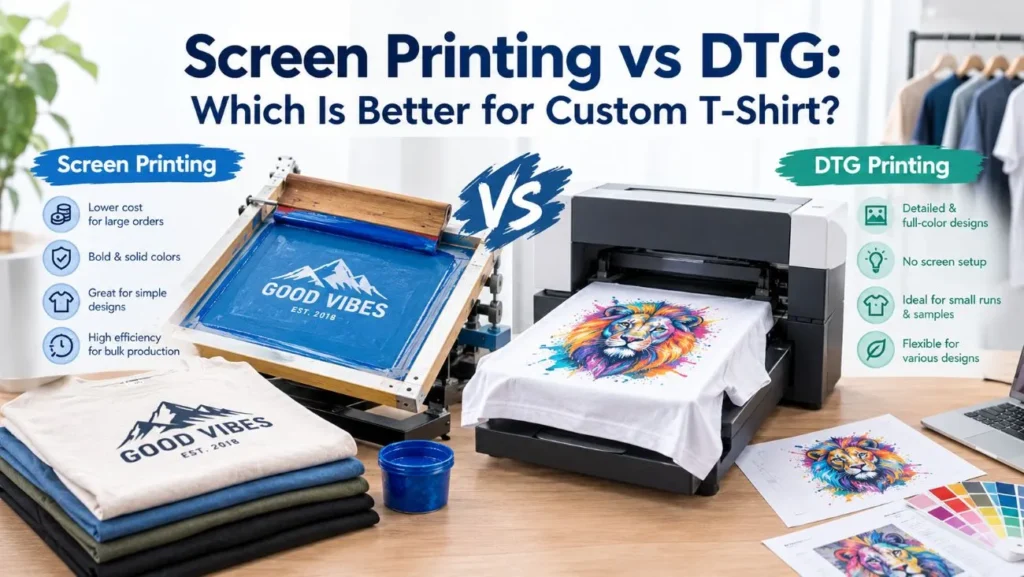
Choosing the right printing method is an important decision when developing a custom T-shirt collection. Two popular options are screen printing and direct-to-garment (DTG) printing. Both can produce attractive designs, but they differ in setup costs, production efficiency, fabric compatibility, and the types of artwork they handle best.
For clothing brands, wholesalers, and private label businesses, understanding screen printing vs DTG can help you select the right process for your product positioning and order quantity. This guide compares both methods and explains how to choose the best option for your custom T-shirt manufacturing project.
What Is Screen Printing?
Screen printing is a traditional printing method that uses a mesh screen and a stencil to transfer ink onto a garment. Each color in a design generally requires a separate screen, making the process particularly suitable for designs with defined colors and repeat production runs.
After the screens are prepared, ink is pushed through the open areas of the stencil onto the T-shirt. The printed garment is then cured according to the ink system and production requirements.
Advantages of Screen Printing
- Cost-effective for larger orders: Initial screen preparation costs can be spread across more garments.
- Strong color coverage: Suitable inks can create bold, opaque graphics and clear brand logos.
- Wide design applications: Commonly used for promotional T-shirts, branded apparel, uniforms, and fashion graphics.
- Repeat production: Once the setup is established, the same design can be reproduced efficiently across larger quantities.
- Multiple ink effects: Depending on the equipment and ink system, special effects such as puff, metallic, or high-density prints may be possible.
Limitations of Screen Printing
- Screen preparation creates setup costs before production begins.
- Designs with many colors or complex gradients may require more preparation and cost.
- Small orders can be less economical because setup costs are spread across fewer pieces.
- Print results depend on the ink, fabric, artwork, curing conditions, and production quality.
What Is DTG Printing?
DTG stands for direct-to-garment printing. This digital printing method applies specialized textile ink directly onto a T-shirt using an inkjet-style printer. Instead of preparing a separate screen for each color, the printer reproduces the artwork digitally.
DTG is especially useful for detailed, multicolor artwork, photographs, illustrations, and designs that contain gradients. Depending on the fabric and printing system, pretreatment may be required, particularly for dark garments. The ink must also be cured correctly to achieve the intended performance.
Advantages of DTG Printing
- Detailed artwork: Can reproduce intricate illustrations, fine details, and multicolor images.
- No conventional screen setup: Artwork can be prepared digitally without making a separate screen for each color.
- Suitable for short runs: Can be practical for samples, limited editions, and small quantities.
- Design flexibility: Makes it easier to produce different artwork variations within a small batch.
- Useful for product testing: Brands can test graphic designs before committing to a larger production run.
Limitations of DTG Printing
- Printing speed and unit economics vary with artwork size, garment color, and equipment.
- Results depend heavily on fabric composition, surface structure, pretreatment, and ink compatibility.
- Dark garments may require additional preparation and white-ink printing.
- DTG is not automatically the most economical choice for large bulk orders.
- Color appearance and wash performance should be tested on the actual garment before bulk production.
Screen Printing vs DTG: Key Differences
The main difference is how the artwork is transferred to the garment. Screen printing uses prepared screens and ink, while DTG applies digitally processed artwork directly to the fabric.
| Comparison Factor | Screen Printing | DTG Printing |
|---|---|---|
| Printing process | Ink passes through prepared screens | Digital ink is applied directly to the garment |
| Best order profile | Often suitable for medium to large repeat orders | Often suitable for samples and small runs |
| Artwork | Particularly effective for defined colors and bold graphics | Particularly effective for detailed, multicolor images |
| Setup | Screen preparation is required | Digital artwork preparation is required |
| Small quantities | Setup costs can increase unit cost | Can be more practical for short runs |
| Large quantities | Can offer favorable unit economics after setup | Unit cost and production speed depend on the job and equipment |
| Fabric compatibility | Depends on ink system and fabric requirements | Often works best with compatible cotton-rich fabrics |
| Durability | Depends on ink, curing, fabric, and care | Depends on ink, pretreatment, curing, fabric, and care |
Important: These are general comparisons, not universal rules. Actual cost, print quality, and production speed depend on the specific equipment, ink system, design, fabric, and supplier capabilities.
1. Which Method Is More Cost-Effective?
Cost is one of the most important considerations when choosing a custom T-shirt printing method. However, the cheapest option depends on the order quantity, number of print colors, artwork size, garment type, and required finish.
Screen Printing Costs
Screen printing usually involves initial screen preparation and setup. For larger orders with repeat artwork, these costs can be distributed across many pieces, potentially reducing the printing cost per T-shirt.
However, designs requiring multiple screens, specialty inks, or additional print locations can increase setup and production costs.
DTG Printing Costs
DTG avoids conventional screen preparation, which can make it attractive for small orders and designs with many colors. Nevertheless, the final cost can be affected by ink consumption, pretreatment, garment color, print coverage, and machine productivity.
For bulk orders, compare actual quotations instead of assuming that digital printing will always be cheaper.
How Order Quantity Changes the Decision
- Samples and very small runs: DTG may be practical when the artwork and fabric are compatible.
- Small batches with complex graphics: DTG can reduce the need for multiple screens.
- Medium to large repeat orders: Screen printing is often worth evaluating because setup costs are spread across more units.
- Large orders with simple, limited-color graphics: Screen printing can be particularly competitive.
For a broader understanding of garment pricing, read our guide to custom T-shirt bulk order cost, which explains how fabric, quantity, customization, and other production requirements affect the final quotation.
2. Which Method Is Better for Different Designs?
Your artwork should influence the printing method you choose. A simple logo and a full-color photographic graphic can have very different production requirements.
Choose Screen Printing for:
- Simple logos with a limited number of colors.
- Bold graphics for streetwear and casual apparel.
- Promotional T-shirts produced in larger quantities.
- Uniforms and branded merchandise with repeat designs.
- Projects requiring specific compatible ink effects.
Choose DTG for:
- Photographic prints and detailed illustrations.
- Complex artwork with multiple colors and gradients.
- Small batches with different design variations.
- Sample development and limited-edition collections.
- Projects where digital artwork flexibility is a priority.
Before production, confirm the artwork file requirements, print dimensions, placement, color expectations, and whether the design needs a white underbase. These details can affect both the final appearance and the production cost.
3. Screen Printing vs DTG for Different Fabrics
Fabric selection affects print appearance, hand feel, and durability. A printing method that performs well on one T-shirt fabric may produce different results on another.
Cotton T-Shirts
Cotton is widely used for both screen printing and DTG. It is a common choice for everyday T-shirts, promotional apparel, and private label collections. DTG is particularly associated with cotton-rich garments, although the best results depend on the printer and ink system.
Cotton-Polyester Blends
Blended fabrics can be used with suitable printing systems, but dye migration, heat sensitivity, and surface characteristics may affect the result. Confirm compatibility with the printing provider before approving a bulk order.
Heavyweight and Textured Fabrics
Heavyweight cotton T-shirts are popular in premium basics and streetwear. Fabric texture, surface smoothness, and garment construction can affect print clarity and feel. Request a sample printed on the actual fabric rather than relying only on a print sample from a different garment.
Learn more about material selection in our guide: How to Choose Fabric for Custom T-Shirts: GSM, Cotton, and Blends.
4. Which Printing Method Is More Durable?
Neither screen printing nor DTG is automatically more durable in every situation. Wash performance depends on the ink formulation, application process, curing conditions, fabric, print design, and garment care.
A well-produced screen print can provide strong wash durability. A properly prepared and cured DTG print can also perform well. Poor application or incorrect curing can reduce durability for either method.
Before approving bulk production, check the following:
- Whether the print cracks, peels, or fades after washing.
- Whether the printed area feels too thick or stiff for the intended product.
- Whether the colors remain consistent with the approved sample.
- Whether the print stretches appropriately with the garment.
- Whether the supplier can provide relevant wash-test results when required.
For brands selling premium apparel, sample approval should include both visual inspection and appropriate performance testing.
5. How to Choose the Right Method for Your Brand
The best printing process is the one that meets your product specifications, target price, order quantity, and customer expectations.
| Brand or Project | Method to Evaluate First | Reason |
|---|---|---|
| Promotional T-shirts | Screen printing | Often suitable for repeat designs and larger quantities |
| Streetwear with bold graphics | Screen printing | Useful for defined-color graphics and compatible specialty inks |
| Photo-print T-shirts | DTG | Can reproduce detailed, multicolor artwork |
| Small test batches | DTG | Avoids conventional screen setup |
| Large repeat orders | Compare both quotations | Actual unit cost depends on quantity, artwork, and production capability |
If you are launching a new collection and need to control inventory risk, explore our guide to finding a custom T-shirt manufacturer with low MOQ. Discuss your order quantity and printing requirements with the supplier before selecting the final process.
6. What Should You Ask Your T-Shirt Manufacturer?
Before confirming a printing method, ask your manufacturer or printing partner specific questions about production capability, sample quality, and pricing.
- Which printing methods are available for my design?
- What is the recommended method for my fabric composition and GSM?
- How does the unit cost change at different order quantities?
- Are setup, screens, pretreatment, and other charges included in the quotation?
- Can you produce a sample using the actual garment and artwork?
- What file format, resolution, and color specifications do you require?
- What print size and placement do you recommend?
- Can you provide wash-test results or other relevant quality checks?
- What is the estimated sampling and bulk production lead time?
- How will the print be inspected before shipment?
For a complete supplier evaluation process, see our guide on how to find a reliable T-shirt manufacturer in China.
7. Common Mistakes to Avoid
Choosing Based Only on Unit Price
A low printing price does not necessarily mean the best value. Compare setup charges, garment quality, print performance, rejected pieces, and the complete order cost.
Ignoring Fabric Compatibility
Do not assume that every printing process works equally well on cotton, polyester blends, and textured fabrics. Test the intended combination before bulk production.
Skipping the Printed Sample
Artwork on a computer screen may not look identical when printed on fabric. Approve a physical sample to evaluate color, placement, scale, and hand feel.
Overlooking Wash Performance
Appearance immediately after printing is only one quality factor. Consider appropriate wash testing and confirm care instructions for the finished garment.
Failing to Confirm All Production Charges
Ask whether the quotation includes screens, setup, pretreatment, special inks, additional print locations, and other applicable charges.
Frequently Asked Questions
Is screen printing better than DTG for custom T-shirts?
Screen printing is often a strong option for larger repeat orders and bold graphics with limited colors. DTG can be better suited to small batches and detailed, multicolor artwork. The right choice depends on your design, fabric, quantity, and budget.
Is DTG cheaper than screen printing?
DTG can be economical for small runs because it avoids conventional screen setup. Screen printing can offer a lower unit cost for larger repeat orders. Request quotations at your actual order quantity to compare accurately.
Does DTG work on 100% cotton T-shirts?
Yes. Cotton is commonly used for DTG printing. However, results still depend on fabric quality, garment color, pretreatment, ink, and the printer’s process.
Which printing method is better for complex designs?
DTG is often suitable for photographs, gradients, and intricate multicolor artwork. Screen printing can also reproduce complex designs, but multiple colors may require additional setup and production steps.
Which method lasts longer after washing?
Neither method is guaranteed to last longer in every case. Ink quality, curing, pretreatment, fabric, and garment care all affect wash durability. Test a sample before approving bulk production.
Can I combine screen printing and DTG in one collection?
Yes. A brand can use different printing methods for different designs or product lines. For example, screen printing may suit a large run of logo T-shirts, while DTG may suit limited-edition artwork. Confirm production feasibility and color consistency with your supplier.
Conclusion: Screen Printing vs DTG for Custom T-Shirts
When comparing screen printing vs DTG, there is no single method that is best for every custom T-shirt project.
- Choose screen printing when you need efficient repeat production, bold graphics, or potentially favorable unit economics at larger quantities.
- Choose DTG when you need detailed multicolor artwork, design flexibility, or a practical option for smaller runs.
Before making your decision, evaluate the fabric, artwork, order quantity, target cost, print feel, durability, and production timeline. Requesting a sample and comparing itemized quotations can help you select the most suitable process for your brand.
Develop Your Custom T-Shirt Collection with Beyson Apparel
Beyson Apparel supports B2B clothing brands with OEM and ODM apparel manufacturing solutions. If you are developing custom T-shirts, our team can discuss your fabric, design, branding, order quantity, and production requirements.
Share your artwork, target quantity, preferred fabric, and delivery market to begin discussing your project.
Contact our team: sales@beysonapparel.com
* This article was written by the manufacturing team of Beyson Apparel. We are a clothing ODM/OEM factory with 15+ years of experience, covering products such as Underwear, T-shirt, Polo Shirts, Hoodies, Pajamas, Shorts and more. Direct inquiry, reply within 12 hours *