
 Call us now:

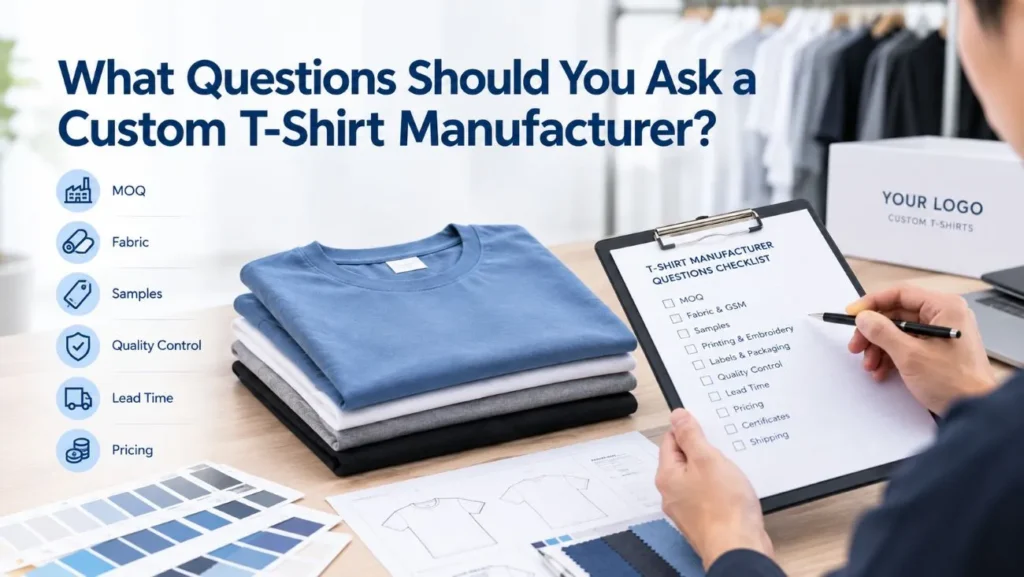
Choosing a custom T-shirt manufacturer is an important decision for clothing brands, retailers, startups, and private label businesses. The right manufacturing partner can help you develop the right product, control production costs, maintain consistent quality, and scale your orders as your brand grows.
However, comparing manufacturers based only on unit price or product photos can lead to expensive mistakes. Before placing a bulk order, buyers should ask detailed questions about the factory, fabric, MOQ, sampling, customization, quality control, production capacity, lead time, and pricing.
This guide provides a practical list of questions to ask a custom T-shirt manufacturer before choosing a supplier or starting bulk production.
Why Should You Ask Questions Before Choosing a T-Shirt Manufacturer?
Custom T-shirt production involves much more than cutting and sewing fabric. Your manufacturer may need to manage fabric sourcing, pattern development, sampling, printing, embroidery, labels, packaging, quality inspection, and export logistics.
Different manufacturers may offer very different capabilities even when they advertise similar products. One supplier may specialize in basic bulk T-shirts, while another may provide OEM and ODM development for private label brands.
Asking the right questions helps you understand whether a manufacturer can actually meet your product requirements.
If you are still comparing suppliers, our guide on how to find a reliable T-shirt manufacturer in China provides a broader supplier evaluation framework.
1. Do You Manufacture T-Shirts in Your Own Factory?
One of the first questions to ask is whether the supplier operates its own production facility or works primarily as a trading company.
A trading company is not automatically a poor choice, but you should understand how production is managed. If production is outsourced, ask who controls fabric sourcing, sampling, quality inspection, and bulk manufacturing.
If the supplier operates its own factory, ask for information such as:
- Factory location
- Production facilities
- Number of production lines
- Manufacturing experience
- Production workers
- Monthly production capacity
- Quality control procedures
You can also ask whether the factory supports factory visits or virtual factory tours. This can help you verify whether the manufacturer’s actual capabilities match its website or quotation.
2. How Many Years Have You Been Manufacturing T-Shirts?
Manufacturing experience can provide useful information about a supplier’s technical knowledge and production stability.
Instead of asking only how long the company has existed, ask specifically about its experience producing the type of T-shirts you want to develop.
For example:
- How long have you produced custom T-shirts?
- Do you manufacture heavyweight T-shirts?
- Do you produce oversized or streetwear T-shirts?
- Do you work with premium fabrics?
- Do you support private label T-shirt production?
A manufacturer experienced in basic promotional T-shirts may not necessarily have the same capabilities as a factory producing premium fashion or private label collections.
3. What T-Shirt Fabrics Can You Provide?
Fabric is one of the most important parts of a T-shirt. It affects hand feel, appearance, durability, shrinkage, weight, drape, and production cost.
Ask your manufacturer which fabrics they can source and whether they can customize fabric specifications.
Useful questions include:
- What fabric compositions do you offer?
- Can you provide 100% cotton?
- Do you offer organic cotton?
- Can you source cotton blends?
- What GSM options are available?
- Can you develop custom fabric specifications?
- Can you provide fabric swatches before sampling?
- How do you control fabric consistency between orders?
For a detailed explanation of T-shirt fabrics, see our guide: How to Choose Fabric for Custom T-Shirts: GSM, Cotton, and Blends .
4. What GSM Options Do You Recommend?
GSM, or grams per square meter, indicates the weight of the fabric. It is particularly important when developing custom T-shirts because different GSM levels create different product characteristics.
Instead of simply asking for the “best GSM,” explain how you want the finished T-shirt to look and feel.
For example:
- Lightweight summer T-shirt
- Regular everyday T-shirt
- Premium heavyweight T-shirt
- Oversized streetwear T-shirt
- Soft luxury T-shirt
A professional manufacturer should be able to recommend suitable fabric weights based on the product’s intended use and target market.
5. What Is Your MOQ Per Style and Color?
MOQ means Minimum Order Quantity. This is one of the most important questions for startups and growing apparel brands.
Do not simply ask, “What is your MOQ?” Instead, clarify whether the MOQ applies per:
- Style
- Color
- Fabric
- Size
- Printing design
- Order
A manufacturer may advertise a low MOQ but apply different minimum quantities when you request custom fabrics, colors, labels, packaging, or special printing.
If MOQ is particularly important for your brand, see: Custom T-Shirt Manufacturer with Low MOQ: A Guide for Growing Apparel Brands .
6. Do You Offer OEM and ODM T-Shirt Manufacturing?
OEM and ODM are two different approaches to custom apparel manufacturing.
OEM T-Shirt Manufacturing
With OEM production, the brand normally provides the design, specifications, artwork, measurements, branding requirements, and other technical information. The manufacturer produces the T-shirt according to those specifications.
ODM T-Shirt Manufacturing
ODM manufacturing generally provides more product development support. Depending on the supplier, this may include fabric recommendations, pattern development, design adaptation, sample development, and construction suggestions.
Ask the manufacturer which services are included and whether additional development fees apply.
7. Can You Produce a Sample Before Bulk Production?
A sample should normally be approved before a large production order begins.
Ask:
- Can you make a custom sample?
- How long does sample development take?
- What is the sample fee?
- How many revisions are possible?
- Can you modify the sample after fitting?
- Will the approved sample become the bulk production reference?
A proper sample allows you to evaluate fabric, measurements, fit, stitching, printing, labels, and overall appearance before committing to bulk production.
8. Can You Produce According to a Tech Pack?
If your brand already has a technical specification package, ask whether the manufacturer can work directly from your tech pack.
A professional manufacturer should be able to review information such as:
- Technical drawings
- Garment measurements
- Fabric composition
- GSM
- Construction details
- Stitching requirements
- Color references
- Printing artwork
- Label specifications
- Packaging instructions
If you do not have a complete tech pack, ask whether the manufacturer can help convert your product concept into production specifications.
9. What Printing and Branding Methods Do You Offer?
Custom T-shirt branding can involve much more than a basic screen print.
Depending on the manufacturer, available options may include:
- Screen printing
- Digital printing
- Heat transfer printing
- Sublimation
- Embroidery
- Woven labels
- Printed neck labels
- Custom hang tags
- Custom packaging
Ask which methods are suitable for your fabric and artwork. The cheapest printing method is not always the best option for a premium product.
10. Can You Customize the Fit and Construction?
If you are building a private label clothing brand, a custom T-shirt should not necessarily be treated as a blank T-shirt with a logo added.
Ask whether the manufacturer can customize:
- Regular fit
- Relaxed fit
- Oversized fit
- Body length
- Sleeve length
- Shoulder width
- Neckline
- Collar rib
- Stitching
- Garment finishing
For premium products, collar construction and garment finishing can have a significant impact on the final appearance and wearing experience.
11. Can You Provide Custom Labels and Packaging?
For private label brands, branding should usually be considered as part of the complete product rather than an afterthought.
Ask whether the manufacturer can provide:
- Custom neck labels
- Woven labels
- Care labels
- Size labels
- Hang tags
- Barcodes
- Individual polybags
- Custom boxes
- Branded packaging
Also ask about the MOQ and additional cost for each branding or packaging component.
12. What Quality Control Process Do You Use?
Quality control is one of the most important areas to discuss before placing a bulk order.
Ask the manufacturer:
- When are quality inspections performed?
- Is fabric inspected before cutting?
- Are measurements checked during production?
- How are printing and embroidery defects handled?
- Is there a final inspection before shipment?
- How are defective products handled?
You should also ask whether the bulk production is compared against the approved pre-production sample.
13. What Certifications and Compliance Standards Do You Have?
Depending on your target market, certifications and social compliance may be important when selecting a manufacturer.
Ask the supplier which certifications currently apply to its factory, materials, and production processes.
Depending on the project, buyers may ask about:
- OEKO-TEX
- GOTS
- BSCI
- FSC
- Other relevant textile or social compliance standards
Do not simply rely on a logo shown on a website. If a certification is important to your project, request the relevant documentation and confirm its scope and validity.
14. What Is Your Production Lead Time?
Production lead time can affect your product launch schedule, inventory planning, and cash flow.
Ask the manufacturer to separate the timeline into different stages:
- Fabric sourcing
- Sample development
- Sample revision
- Final sample approval
- Material preparation
- Bulk production
- Quality inspection
- Packing
- Shipment
Also ask how production schedules are affected during peak seasons.
15. Can You Handle Repeat Orders?
A manufacturer may be able to produce your first order successfully but still struggle with repeat production.
For long-term brands, consistency between production runs is extremely important.
Ask how the manufacturer manages:
- Fabric reorders
- Color consistency
- Pattern storage
- Approved samples
- Production specifications
- Branding specifications
- Quality standards
A reliable manufacturer should be able to maintain your approved specifications for future production.
16. How Do You Calculate the T-Shirt Price?
Instead of asking only, “What is your price?”, ask what is included in the quotation.
A custom T-shirt quotation may include:
- Fabric
- Cutting and sewing
- Printing or embroidery
- Labels
- Packaging
- Sampling
- Quality control
- Other production charges
A supplier offering a lower unit price may not actually be cheaper if important customization or packaging costs are excluded.
For a detailed breakdown of T-shirt manufacturing costs, see: Custom T-Shirt Bulk Order Cost: A B2B Pricing Guide .
17. Can You Support Low MOQ Orders and Future Scaling?
Startups and growing brands often need flexibility at the beginning of their business.
A manufacturer that supports low MOQ production can allow a brand to test new designs, colors, and fabrics before committing to larger quantities.
However, low MOQ should not come at the expense of production quality.
Ask whether the manufacturer can support both your initial small order and future larger production runs.
This is especially important if your business model involves testing products first and scaling successful styles later.
18. Can You Help With Fabric and Product Development?
A good manufacturing partner should not simply wait for a finished design file. If you are developing a new product, ask whether the manufacturer can provide technical recommendations.
For example, the manufacturer may be able to advise on:
- Fabric composition
- GSM
- Collar construction
- Fit and measurements
- Printing methods
- Embroidery
- Garment washing
- Labels
- Packaging
This type of development support can be particularly valuable for startups that have a product concept but limited manufacturing experience.
19. Can You Ship to My Target Market?
International apparel buyers should also ask about export and shipping capabilities.
Useful questions include:
- Which countries do you regularly export to?
- Can you arrange international shipping?
- Which shipping methods are available?
- Can you support DDP or other delivery terms?
- What export documentation can you provide?
Shipping should be considered as part of the overall landed cost rather than evaluated separately from the factory quotation.
20. What Should You Send the Manufacturer Before Requesting a Quote?
The quality of the quotation often depends on how much information you provide.
Before requesting a quote, prepare as much of the following information as possible:
- T-shirt style
- Technical drawing or reference image
- Fabric composition
- GSM
- Color requirements
- Size range
- Logo artwork
- Printing or embroidery requirements
- Label requirements
- Packaging requirements
- Estimated order quantity
- Target market
- Expected delivery date
The more complete your specifications are, the easier it is for a manufacturer to provide an accurate and comparable quotation.
Custom T-Shirt Manufacturer Questions Checklist
| Area | Question to Ask | Why It Matters |
|---|---|---|
| Factory | Do you manufacture in your own factory? | Helps verify production capabilities and control. |
| Experience | How long have you manufactured T-shirts? | Shows relevant production experience. |
| Fabric | What fabrics and GSM options are available? | Determines product quality and positioning. |
| MOQ | What is the MOQ per style and color? | Helps manage inventory and investment. |
| OEM/ODM | Do you provide OEM and ODM services? | Shows the level of development support. |
| Samples | Can you provide samples before bulk production? | Reduces production risk. |
| Branding | What printing, labels, and packaging can you provide? | Confirms customization capabilities. |
| Quality | What quality control procedures do you use? | Helps ensure consistent bulk production. |
| Lead Time | What are your sample and bulk lead times? | Helps plan product launches and inventory. |
| Pricing | What is included in the quoted price? | Makes supplier comparisons more accurate. |
How to Compare the Answers From Different Manufacturers
Once you contact several suppliers, avoid choosing a manufacturer based on one factor such as price.
Instead, compare each manufacturer across several categories:
- Product quality
- Fabric options
- Customization capabilities
- MOQ flexibility
- Sample development
- Quality control
- Production capacity
- Lead time
- Communication
- Total production cost
A manufacturer with a slightly higher unit price may provide better fabric, stronger quality control, faster communication, and more reliable production. For a long-term clothing brand, these factors can be more valuable than saving a small amount on the initial unit price.
Red Flags to Watch for When Choosing a T-Shirt Manufacturer
The questions above can also help you identify potential warning signs.
1. The Supplier Avoids Specific Answers
If a manufacturer cannot clearly explain MOQ, lead time, fabric specifications, or quality control, ask for more detailed information before moving forward.
2. The Price Is Much Lower Than Other Suppliers
An unusually low quotation may indicate differences in fabric quality, construction, customization, packaging, or services included in the price.
3. The Supplier Does Not Recommend Sampling
For a custom product, skipping the sample stage can create significant production risks.
4. The Manufacturer Cannot Explain Its Production Process
A professional manufacturer should be able to explain how your T-shirt moves from fabric preparation to cutting, sewing, printing, inspection, packing, and shipment.
5. Communication Is Consistently Unclear
Poor communication during the quotation stage can become a larger problem when technical specifications, samples, and production changes need to be managed.
Why Work With an Experienced Custom T-Shirt Manufacturer?
The right manufacturing partner should provide more than basic garment production. For a growing clothing brand, the manufacturer may become an important part of the product development and supply chain process.
Beyson Apparel provides OEM and ODM apparel manufacturing services for brands, retailers, wholesalers, and private label businesses. T-shirt services can include fabric sourcing, product development, sampling, custom printing, embroidery, labels, packaging, quality control, and bulk production.
The company also provides manufacturing for other apparel categories, including underwear, polo shirts, hoodies, pajamas, and shorts.
If you are looking for a manufacturing partner, you can learn more about custom T-shirt manufacturing with low MOQ or explore the complete guide to custom T-shirt bulk order cost .
Final Thoughts
Choosing the right custom T-shirt manufacturer requires more than requesting a price list.
Before placing an order, ask about the manufacturer’s factory, experience, fabric options, GSM, MOQ, OEM and ODM capabilities, sample development, customization, quality control, certifications, production capacity, lead time, pricing, and export services.
Most importantly, make sure the manufacturer understands your product requirements and can consistently reproduce the approved specifications during bulk production and future repeat orders.
By asking the right questions before production, clothing brands can reduce sourcing risks, compare suppliers more accurately, and build stronger long-term manufacturing relationships.
Ready to Develop Your Custom T-Shirt?
Share your T-shirt design, fabric requirements, quantity, branding specifications, or packaging ideas with Beyson Apparel to discuss your OEM/ODM project.
Email: sales@beysonapparel.com
* This article was written by the manufacturing team of Beyson Apparel. We are a clothing ODM/OEM factory with 15+ years of experience, covering products such as Underwear, T-shirt, Polo Shirts, Hoodies, Pajamas, Shorts and more. Direct inquiry, reply within 12 hours *